Restoration strategies for out-planting at marginalized coastal leeward landscapes on Hawaii Island



Native vegetative restoration projects on arid coastal landscapes can be difficult in the first year of development due to a host of environmental stressors and/or resource limits. Water availability and distribution is but one challenge to land managers; however, the dilemma is compounded by decades of soil erosion and the marginalization of the soil’s water and
nutrient-holding capacity. It is well documented that re-vegetating degraded landscapes can increase SOM, water and nutrient holding capacity and will reduce sediment run-off. However, typical to arid leeward coastal ecosystems, high radiation exposure, lack of precipitation, extreme wind events and climate change (i.e. extreme rain events and prolonged drought) decreases survival and growth rates of undeveloped native species. Here we investigate restoration methods.
Introduction:
Native vegetative restoration projects on arid coastal landscapes can be difficult in the first year of development due to a host of environmental stressors and/or resource limits. Water availability and distribution is but one challenge to land managers; however, the dilemma is compounded by decades of soil erosion and the marginalization of the soil’s water and
nutrient-holding capacity. It is well documented that re-vegetating degraded landscapes can increase SOM, water and nutrient holding capacity and will reduce sediment run-off. However, typical to arid leeward coastal ecosystems, high radiation exposure, lack of precipitation, extreme wind events and climate change (i.e. extreme rain events and prolonged drought) decreases survival and growth rates of undeveloped native species. Here we investigate restoration methods.

‘GROWTH’ rate of MFA findings suggest that:
- GROWTH RATE as a function of SHADE * SPECIES (probability F value = 3.36 x 10⁵; DF = 1);
- GROWTH RATE is HIGHLY dependent upon SHADE (probability F value = 0.003 ; DF = 1); HOWEVER, interactively:
- GROWTH RATE is HIGHLY dependent upon SPECIES (probability F value = 0.008 ; DF = 5)
Results: Growth Rates
‘GROWTH’ rate of MFA findings suggest that:
- GROWTH RATE as a function of SHADE * SPECIES (probability F value = 3.36 x 10⁵; DF = 1);
- GROWTH RATE is HIGHLY dependent upon SHADE (probability F value = 0.003 ; DF = 1); HOWEVER, interactively:
- GROWTH RATE is HIGHLY dependent upon SPECIES (probability F value = 0.008 ; DF = 5)

Our study site is on the Island of Hawaii, in the ahupua'a of Puanui located in the district of Kohala. The area is operated by Ka Ike O Ka Aina – a non-profit 501 (c)(3) organization, who has leased the 40 acre property from Kamehameha Schools Bishop Estate, with a mission to restore and perpetuate the natural and cultural resources of Kohala. Puanui elevation is 0 to 100 feet and receives less than 250 mm (< 30 mm: June – August; ~ 100 mm; December - February) of rainfall annually (Giambelluca et al. 2017). Diurnal temperature fluxes range between 22ᵒ C and 34ᵒ C (http://www.ulumaupuanui.org/weather).
We selected the hottest and driest month of the year to out-plant so to consider for misrepresentation that does not compensate for the wet and cooler months in the winter. 100 individuals were planted on an alluvial gradient in May and another 100 in June of 2018. 40 samples from the May planting were omitted from the data-set because of irrigation inconsistencies – a majority of those individuals perished from a lack of resources early on in the study. Because of low population size (n = 3 to 5 individuals per species) Hala (Pandanus tectorius-HAL), Pohinahina (Vitex rotundifolia-POH), Ukiuki (Dianella sandwicensis-UKI) and Wiliwili (Erythrina sandwicensis-WIL) were also removed from the dataset but later used in an attrition test.
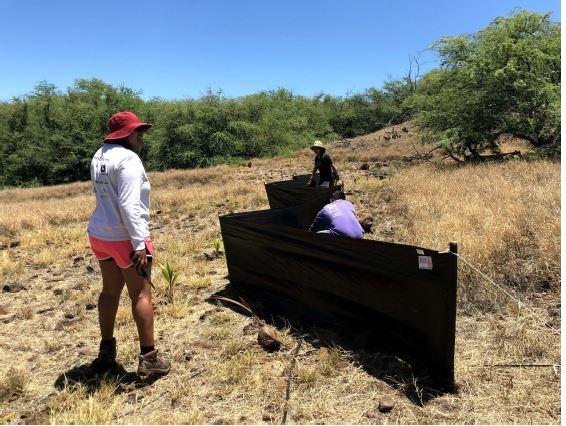
The total data set was measured qualitatively for survival and growth.
‘Living’ (Live) and ‘Not-Living’ (Dead) subsets were created, then nine-month growth anomalies (individual deviation from each species mean) were established for the ‘Living’ samples. Then two Multi-factorial ANOVA’s (MFA) were created for the purpose of this analyses to establish a

level of certainty between our dependent variables (survival and growth - separately) of five native plant species – two under-story shrubs: Ilima (Sida fallax-ILM) and Naupaka (Scaevola gaudichaudii-NAP); and three tree species: Kou (Cordia subcordata-KOU), Milo (Thespesia populnea-MLO) and Kamani (Calophyllum inophyllum-KAM) as a function of three treatments (independent variables): ‘SHADE’ - natural (NAT) and installed (ART), ‘MULCH’, and a ‘CONTROL’ (0) that has no treatment.
Methods:
Our study site is on the Island of Hawaii, in the ahupua'a of Puanui located in the district of Kohala. The area is operated by Ka Ike O Ka Aina – a non-profit 501 (c)(3) organization, who has leased the 40 acre property from Kamehameha Schools Bishop Estate, with a mission to restore and perpetuate the natural and cultural resources of Kohala. Puanui elevation is 0 to 100 feet and receives less than 250 mm (< 30 mm: June – August; ~ 100 mm; December - February) of rainfall annually (Giambelluca et al. 2017). Diurnal temperature fluxes range between 22ᵒ C and 34ᵒ C (http://www.ulumaupuanui.org/weather).
We selected the hottest and driest month of the year to out-plant so to consider for misrepresentation that does not compensate for the wet and cooler months in the winter. 100 individuals were planted on an alluvial gradient in May and another 100 in June of 2018. 40 samples from the May planting were omitted from the data-set because of irrigation inconsistencies – a majority of those individuals perished from a lack of resources early on in the study. Because of low population size (n = 3 to 5 individuals per species) Hala (Pandanus tectorius-HAL), Pohinahina (Vitex rotundifolia-POH), Ukiuki (Dianella sandwicensis-UKI) and Wiliwili (Erythrina sandwicensis-WIL) were also removed from the dataset but later used in an attrition test.
The total data set was measured qualitatively for survival and growth.
‘Living’ (Live) and ‘Not-Living’ (Dead) subsets were created, then nine-month growth anomalies (individual deviation from each species mean) were established for the ‘Living’ samples. Then two Multi-factorial ANOVA’s (MFA) were created for the purpose of this analyses to establish a
level of certainty between our dependent variables (survival and growth - separately) of five native plant species – two under-story shrubs: Ilima (Sida fallax-ILM) and Naupaka (Scaevola gaudichaudii-NAP); and three tree species: Kou (Cordia subcordata-KOU), Milo (Thespesia populnea-MLO) and Kamani (Calophyllum inophyllum-KAM) as a function of three treatments (independent variables): ‘SHADE’ - natural (NAT) and installed (ART), ‘MULCH’, and a ‘CONTROL’ (0) that has no treatment.

‘SURVIVAL’ rate of MFA findings suggest that:
- SURVIVAL is NOT a factor associated with SHADE (probability F value = 0.10 ; DF = 1)
- SURVIVAL is HIGHLY dependent upon MULCH (probability F value = 0.009 ; DF = 1)
- SURVIVAL is HIGHLY dependent upon SPECIES (probability F value = 8.06 x 10¹⁵ ; DF = 10)


Results: Survival Rates
‘SURVIVAL’ rate of MFA findings suggest that:
- SURVIVAL is NOT a factor associated with SHADE (probability F value = 0.10 ; DF = 1)
- SURVIVAL is HIGHLY dependent upon MULCH (probability F value = 0.009 ; DF = 1)
- SURVIVAL is HIGHLY dependent upon SPECIES (probability F value = 8.06 x 10¹⁵ ; DF = 10)

After a close observation of various data plots created post-analyses, we noticed that survival rates did not exhibit a normal distribution between species; specifically, Niu (Coconut; Cocos nucifera) – an over-representation of attrition – against all other species. As was with the 40 samples omitted from the original dataset based upon water inconsistencies and lack species population size necessary for a third treatment, Niu was not; it had 50 individuals – 25 at half the irrigation volume of the other 25. Although water volume and irrigation frequency were held constant throughout our analyses, we did conduct a separate analysis on survival of Niu based upon irrigation rates – comparing 0.95 L (32 oz) and 0.47 L (16 oz) per day – 90 percent of the 0.47 L treatment died. Unlike most of the species tested in this study, Niu did not produce any notable factors on growth or survival rates as a function of MULCH or SHADE, but certainly our results suggest that at least 1 liter of irrigation water is necessary for the first nine months of growth.

In conclusion, we suggest that future restoration efforts include at least mulching of young saplings at or near the time of planting. Further, we want to emphasize plant species as the foremost criteria for restoration at similar landscapes. We suggest that T. populnea (tree canopy), S. gaudichaudii (shrub understory) and S. fallax (ground-cover) are the most available, historically typical and resilient for out-planting candidates during the initial phases of a restoration project at marginalized coastal leeward landscapes on Hawaii Island.
C. subcordata and C. nucifera are also potential candidates for canopy species selection, given, ample water is available. Although some species underwent 100 percent attrition – P. tectorius (tree), V. rotundifolia (shrub) and D. sandwicensis (ground-cover) – they are typical to arid leeward coastal landscapes across the Hawaiian archipelago, should not be excluded from potential restoration and perhaps could be introduced well after soil structures and companion species are reestablished. Lastly, after nine months of growth, water can be reduced from 0.95 L (32 oz) per day to 0.95 L every other day. Since the irrigation was cut in half, plants are now thriving and exponentially growing.
Discussion:
After a close observation of various data plots created post-analyses, we noticed that survival rates did not exhibit a normal distribution between species; specifically, Niu (Coconut; Cocos nucifera) – an over-representation of attrition – against all other species. As was with the 40 samples omitted from the original dataset based upon water inconsistencies and lack species population size necessary for a third treatment, Niu was not; it had 50 individuals – 25 at half the irrigation volume of the other 25. Although water volume and irrigation frequency were held constant throughout our analyses, we did conduct a separate analysis on survival of Niu based upon irrigation rates – comparing 0.95 L (32 oz) and 0.47 L (16 oz) per day – 90 percent of the 0.47 L treatment died. Unlike most of the species tested in this study, Niu did not produce any notable factors on growth or survival rates as a function of MULCH or SHADE, but certainly our results suggest that at least 1 liter of irrigation water is necessary for the first nine months of growth.
In conclusion, we suggest that future restoration efforts include at least mulching of young saplings at or near the time of planting. Further, we want to emphasize plant species as the foremost criteria for restoration at similar landscapes. We suggest that T. populnea (tree canopy), S. gaudichaudii (shrub understory) and S. fallax (ground-cover) are the most available, historically typical and resilient for out-planting candidates during the initial phases of a restoration project at marginalized coastal leeward landscapes on Hawaii Island.
C. subcordata and C. nucifera are also potential candidates for canopy species selection, given, ample water is available. Although some species underwent 100 percent attrition – P. tectorius (tree), V. rotundifolia (shrub) and D. sandwicensis (ground-cover) – they are typical to arid leeward coastal landscapes across the Hawaiian archipelago, should not be excluded from potential restoration and perhaps could be introduced well after soil structures and companion species are reestablished. Lastly, after nine months of growth, water can be reduced from 0.95 L (32 oz) per day to 0.95 L every other day. Since the irrigation was cut in half, plants are now thriving and exponentially growing.