Thanks for your rating.Server Error!!!You already rated this poster.
Introduction
The biodiversity of forests provides humans with multiple ecosystem services and goods, such as groundwater recharge, erosion protection, climate regulation, medicine, and cultural resources (Bonan, 2008; Constanza et al., 1997).
Twenty-five biodiversity hotspots were identified by Myers, et al. (2000) based on the number of endemic plant species, such that the hotspots cover just 1.4% of the land surface area with 44% of all vascular plant species.
Tropical forests accounted for fifteen out of the twenty-five hotspots and islands accounted for nine with Hawai'i belonging to both categories as one of the biodiversity hotspots (Myers, et al., 2000).
However, anthropogenic activity is threatening the unique biodiversity of Hawai'i through factors such as habitat loss and invasive species (Kingsford, et al., 2009).
Invasive plants were identified as a critical driver behind the decline of native plant diversity in Hawai'i (Caujapé-Castells, et al., 2010), such that Hawai'i is often considered "The Endangered Species Capital of the World" (DOFAW, 2019).
Metrosideros polymorpha ('ōhi'a) is an endemic, keystone tree that is both ecologically and culturally significant in Hawai'i, but the displacement of 'ōhi'a and other native species is threatened by non-native, invasive plants, such as Psidium cattleyanum (strawberry guava) (Caujapé-Castells, et al., 2010).
However, there is a lack of studies testing neighbor effects of native versus invasive plants on islands, especially in Hawai'i (Barton & Wong, 2019).
References
Bonan, G. B. (2008) Forests and climate change: forcings, feedbacks, and the climate benefits of forests. Science, 320(5882), 1444-1449.
Costanza, R., d'Arge, R., De Groot, R., Farber, S., Grasso, M., Hannon, B., ... & Raskin, R. G. (1997) The value of the world's ecosystem services and natural capital. Nature, 387(6630), 253.
Myers, N., Mittermeier, R.A., Mittermeier, C.G., Da Fonseca, G.A. and Kent, J., (2000) Biodiversity hotspots for conservation priorities. Nature, 403(6772), 853.
Kingsford, R.T., Watson, J.E., Lundquist, C.J., Venter, O., Hughes, L., Johnston, E.L., Atherton, J., Gawel, M., Keith, D.A., Mackey, B.G. and Morley, C., (2009) Major conservation policy issues for biodiversity in Oceania. Conservation Biology, 23(4), 834-840.
Caujape-Castells, J., Tye, A., Crawford, D.J., Santos-Guerra, A., Sakai, A., Beaver, K., Lobin, W., Florens, F.V., Moura, M., Jardim, R. and Gómes, I., (2010) Conservation of oceanic island floras: present and future global challenges. Perspectives in Plant Ecology, Evolution and Systematics, 12(2), 107-129.
Division of Forestry and Wildlife (DOFAW), (2019) Rare plant program. Retrieved from https://dlnr.hawaii.gov/ecosystems/rare-plants/.
Barton, K.E. & Wong, A, (2019) Plant competition as a mechanism of invasion on islands: Revisiting the conclusions of Kuebbing and Nuñez (2016). Biotropica, 45(3), 316-318.
The biodiversity of forests provides humans with multiple ecosystem services and goods, such as groundwater recharge, erosion protection, climate regulation, medicine, and cultural resources (Bonan, 2008; Constanza et al., 1997).
Twenty-five biodiversity hotspots were identified by Myers, et al. (2000) based on the number of endemic plant species, such that the hotspots cover just 1.4% of the land surface area with 44% of all vascular plant species.
Tropical forests accounted for fifteen out of the twenty-five hotspots and islands accounted for nine with Hawai'i belonging to both categories as one of the biodiversity hotspots (Myers, et al., 2000).
However, anthropogenic activity is threatening the unique biodiversity of Hawai'i through factors such as habitat loss and invasive species (Kingsford, et al., 2009).
Invasive plants were identified as a critical driver behind the decline of native plant diversity in Hawai'i (Caujapé-Castells, et al., 2010), such that Hawai'i is often considered "The Endangered Species Capital of the World" (DOFAW, 2019).
Metrosideros polymorpha ('ōhi'a) is an endemic, keystone tree that is both ecologically and culturally significant in Hawai'i, but the displacement of 'ōhi'a and other native species is threatened by non-native, invasive plants, such as Psidium cattleyanum (strawberry guava) (Caujapé-Castells, et al., 2010).
However, there is a lack of studies testing neighbor effects of native versus invasive plants on islands, especially in Hawai'i (Barton & Wong, 2019).
References
Bonan, G. B. (2008) Forests and climate change: forcings, feedbacks, and the climate benefits of forests. Science, 320(5882), 1444-1449.
Costanza, R., d'Arge, R., De Groot, R., Farber, S., Grasso, M., Hannon, B., ... & Raskin, R. G. (1997) The value of the world's ecosystem services and natural capital. Nature, 387(6630), 253.
Myers, N., Mittermeier, R.A., Mittermeier, C.G., Da Fonseca, G.A. and Kent, J., (2000) Biodiversity hotspots for conservation priorities. Nature, 403(6772), 853.
Kingsford, R.T., Watson, J.E., Lundquist, C.J., Venter, O., Hughes, L., Johnston, E.L., Atherton, J., Gawel, M., Keith, D.A., Mackey, B.G. and Morley, C., (2009) Major conservation policy issues for biodiversity in Oceania. Conservation Biology, 23(4), 834-840.
Caujape-Castells, J., Tye, A., Crawford, D.J., Santos-Guerra, A., Sakai, A., Beaver, K., Lobin, W., Florens, F.V., Moura, M., Jardim, R. and Gómes, I., (2010) Conservation of oceanic island floras: present and future global challenges. Perspectives in Plant Ecology, Evolution and Systematics, 12(2), 107-129.
Division of Forestry and Wildlife (DOFAW), (2019) Rare plant program. Retrieved from https://dlnr.hawaii.gov/ecosystems/rare-plants/.
Barton, K.E. & Wong, A, (2019) Plant competition as a mechanism of invasion on islands: Revisiting the conclusions of Kuebbing and Nuñez (2016). Biotropica, 45(3), 316-318.
Methods
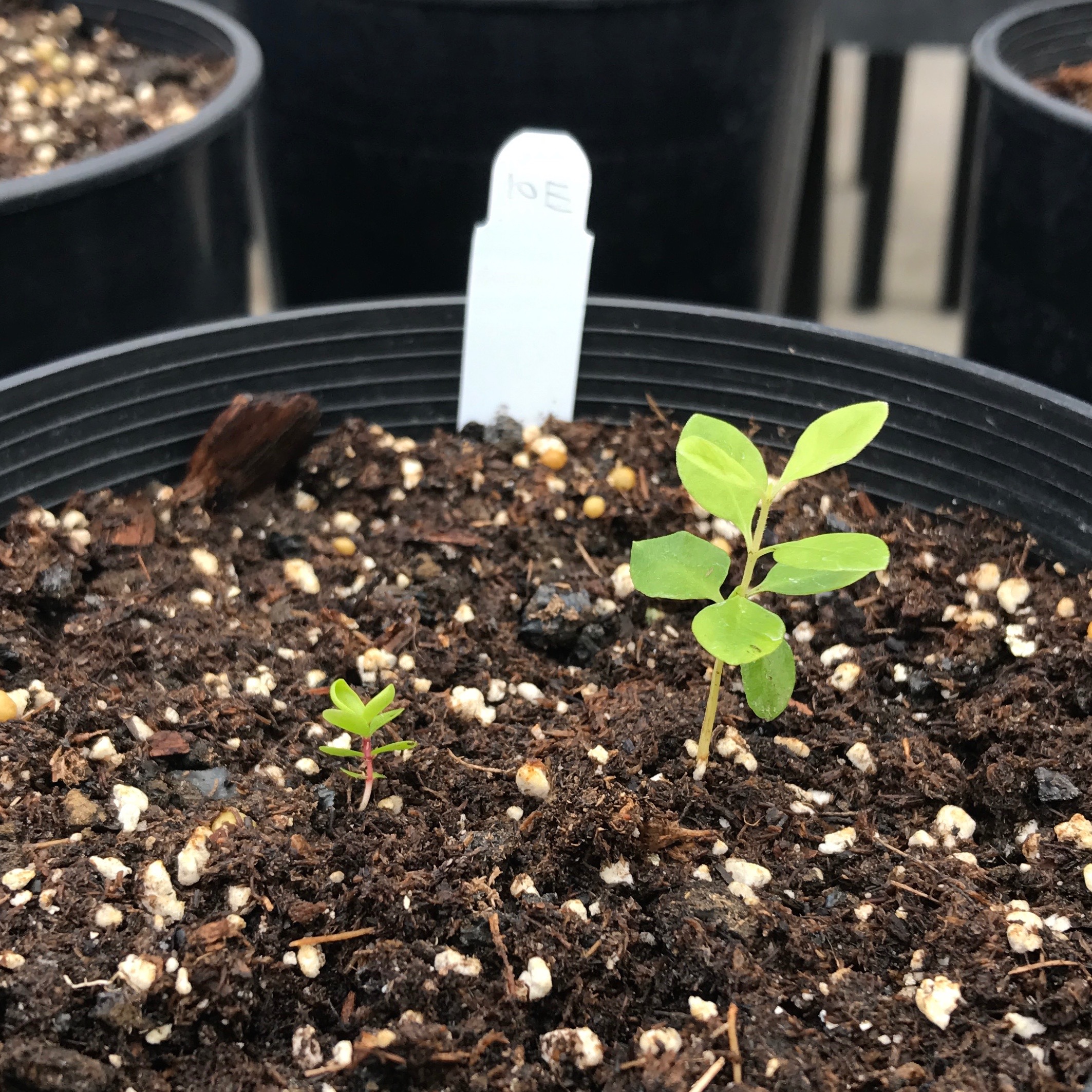
Experimental design with five treatment groups and six focal plants: 'ōhi'a control, 'ōhi'a intraspecific neighbors, 'ōhi'a interspecific with a strawberry guava neighbor, strawberry guava control, strawberry guava intraspecific neighbors, and strawberry guava interspecific with an 'ōhi'a neighbor.
The plant neighbor effects experiment with the endemic 'ōhi'a and invasive strawberry guava was conducted in the botany greenhouse at the University of Hawai'i at Mānoa.
Both species were grown in three different treatments: control with one individual, intraspecific with two individuals of the same species, and interspecific with a mixture of both species.
The focal plant individuals were measured weekly for their performance (survival and seedling height) and for their plant traits (leaf number and chlorophyll content).
All surviving plant shoots were harvested on day 99 of the experiment, and measurements were taken of their plant performance and functional traits, including height, leaf number, stem thickness, leaf biomass, stem biomass, total shoot biomass, leaf:stem biomass ratio, and specific leaf area.
Performance and functional trait data of surviving individuals and pairs were analyzed using ANCOVA and Tukey's HSD test to determine if there is a difference between treatments.
Experimental design with five treatment groups and six focal plants: 'ōhi'a control, 'ōhi'a intraspecific neighbors, 'ōhi'a interspecific with a strawberry guava neighbor, strawberry guava control, strawberry guava intraspecific neighbors, and strawberry guava interspecific with an 'ōhi'a neighbor.
The plant neighbor effects experiment with the endemic 'ōhi'a and invasive strawberry guava was conducted in the botany greenhouse at the University of Hawai'i at Mānoa.
Both species were grown in three different treatments: control with one individual, intraspecific with two individuals of the same species, and interspecific with a mixture of both species.
The focal plant individuals were measured weekly for their performance (survival and seedling height) and for their plant traits (leaf number and chlorophyll content).
All surviving plant shoots were harvested on day 99 of the experiment, and measurements were taken of their plant performance and functional traits, including height, leaf number, stem thickness, leaf biomass, stem biomass, total shoot biomass, leaf:stem biomass ratio, and specific leaf area.
Performance and functional trait data of surviving individuals and pairs were analyzed using ANCOVA and Tukey's HSD test to determine if there is a difference between treatments.
Results Over Time
The change in plant height over time across species and treatment. Repeated measures were collected on the focal individuals of each species and treatment until the plants died or were harvested. The line was fitted to the data using the locally estimated scatterplot smoothing (LOESS) method with the formula y~x.
The change in plant leaf number over time across species and treatment. Repeated measures were collected on the focal individuals of each species and treatment until the plants died or were harvested. The line was fitted to the data using the locally estimated scatterplot smoothing (LOESS) method with the formula y~x.
The number of plants harvested and sampled at the end of the experiment, the number of plants alive before the harvest, and the total number of plants at the beginning of the experiment. The 'ōhi'a intraspecific non-focal (NF) plants were harvested and analyzed, but the strawberry guava intraspecific NF plants were not factored into the analysis.
The change in plant height over time across species and treatment. Repeated measures were collected on the focal individuals of each species and treatment until the plants died or were harvested. The line was fitted to the data using the locally estimated scatterplot smoothing (LOESS) method with the formula y~x.
The change in plant leaf number over time across species and treatment. Repeated measures were collected on the focal individuals of each species and treatment until the plants died or were harvested. The line was fitted to the data using the locally estimated scatterplot smoothing (LOESS) method with the formula y~x.
The number of plants harvested and sampled at the end of the experiment, the number of plants alive before the harvest, and the total number of plants at the beginning of the experiment. The 'ōhi'a intraspecific non-focal (NF) plants were harvested and analyzed, but the strawberry guava intraspecific NF plants were not factored into the analysis.
Results
The effect of neighbor plant species and treatment on plant height. The three treatments were the control with one individual, intraspecific with two individuals of the same species, and interspecific with a mixture of both species.The lowercase letters indicate statistically significant differences across species and treatments utilizing Tukey HSD in R.
The effect of neighbor plant species and treatment on total shoot biomass. The three treatments were the control with one individual, intraspecific with two individuals of the same species, and interspecific with a mixture of both species.The lowercase letters indicate statistically significant differences across species and treatments utilizing Tukey HSD in R.
The effect of neighbor plant species and treatment on leaf:stem biomass ratio. The three treatments were the control with one individual, intraspecific with two individuals of the same species, and interspecific with a mixture of both species.The lowercase letters indicate statistically significant differences across species and treatments utilizing Tukey HSD in R.
The effect of neighbor plant species and treatment on plant height. The three treatments were the control with one individual, intraspecific with two individuals of the same species, and interspecific with a mixture of both species.The lowercase letters indicate statistically significant differences across species and treatments utilizing Tukey HSD in R.
The effect of neighbor plant species and treatment on total shoot biomass. The three treatments were the control with one individual, intraspecific with two individuals of the same species, and interspecific with a mixture of both species.The lowercase letters indicate statistically significant differences across species and treatments utilizing Tukey HSD in R.
The effect of neighbor plant species and treatment on leaf:stem biomass ratio. The three treatments were the control with one individual, intraspecific with two individuals of the same species, and interspecific with a mixture of both species.The lowercase letters indicate statistically significant differences across species and treatments utilizing Tukey HSD in R.
Discussion
'Ōhi'a demonstrated high mortality rates across all treatments.
Strawberry guava exhibited a much higher growth rate than 'ōhi'a, with increases in growth rate over time compared to 'ōhi'a, which are attributed to the bigger seed size of strawberry guava.
Growth rate differences were identified between the strawberry guava treatments, such that the plants in the intraspecific treatment had the lowest mean change in leaf number and height.
Slight neighbor effects were detected between the 'ōhi'a treatments through a higher shoot biomass, which might be attributed to a shift in biomass allocation to shoot production to avoid shade or the presence of a neighbor that provides shade and facilitates 'ōhi'a growth and survival at this stage.
The overall differences in plant performance and functional traits between 'ōhi'a and strawberry guava at this stage might be attributed to asymmetric competition, suggesting that strawberry guava can outgrow and outcompete 'ōhi'a seedlings.
'Ōhi'a demonstrated high mortality rates across all treatments.
Strawberry guava exhibited a much higher growth rate than 'ōhi'a, with increases in growth rate over time compared to 'ōhi'a, which are attributed to the bigger seed size of strawberry guava.
Growth rate differences were identified between the strawberry guava treatments, such that the plants in the intraspecific treatment had the lowest mean change in leaf number and height.
Slight neighbor effects were detected between the 'ōhi'a treatments through a higher shoot biomass, which might be attributed to a shift in biomass allocation to shoot production to avoid shade or the presence of a neighbor that provides shade and facilitates 'ōhi'a growth and survival at this stage.
The overall differences in plant performance and functional traits between 'ōhi'a and strawberry guava at this stage might be attributed to asymmetric competition, suggesting that strawberry guava can outgrow and outcompete 'ōhi'a seedlings.
Next Steps
Plants at the end of the experiment on day 99.
Further research should conduct more experiments on neighbor effects between native and invasive plants in Hawai'i.
Subsequent experiments should test plant neighbor effects with different species pairs and under various environmental conditions, such as drought as a result of climate change.

Further research should conduct more experiments on neighbor effects between native and invasive plants in Hawai'i.
Subsequent experiments should test plant neighbor effects with different species pairs and under various environmental conditions, such as drought as a result of climate change.